Protein Doesn't Travel Alone. You're Eating the Whole Package.
With the protein frenzy going on right now, much of the focus is on "getting your protein in." For most people, that just means chasing a number, grams to hit, whatever gets you there. But food comes with more health considerations than protein content alone.
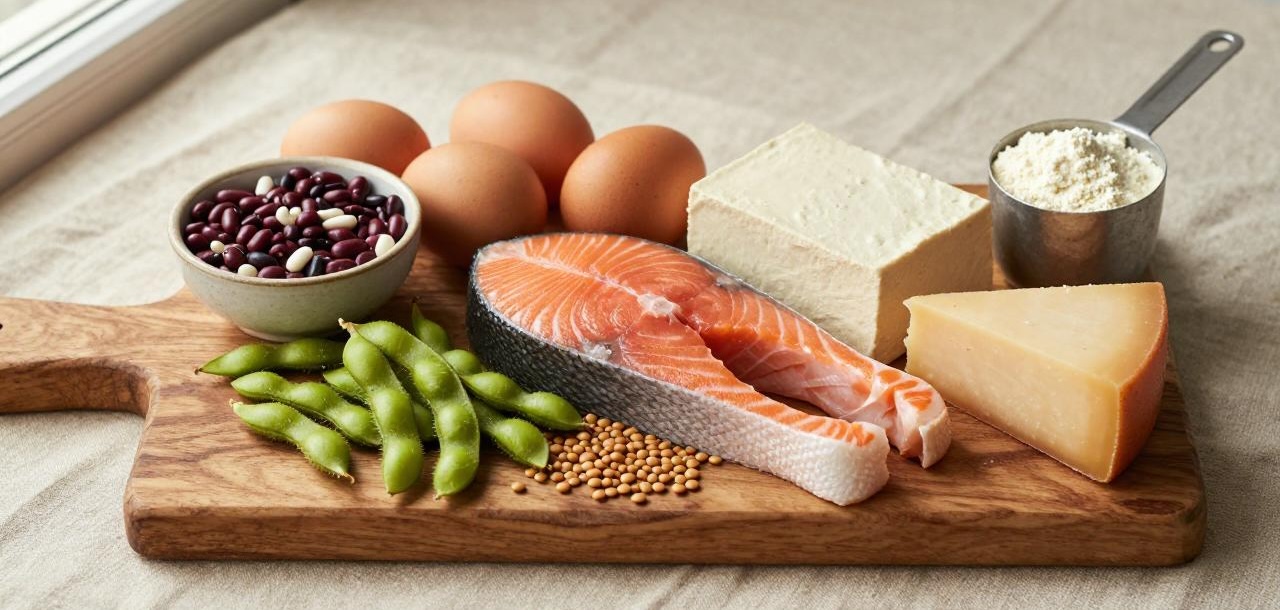
Nothing you eat is just protein, not the salmon, tofu, lentils, or ribeye. Every protein source comes bundled with a whole supporting entourage of fats, fiber, vitamins, and minerals that arrived in the same bite, whether you were thinking about them or not. Nutrition scientists have a name for this: the food matrix, the idea that nutrients aren't just individual units, they're packaged together inside a food's actual structure, and that packaging changes how your body uses them [1].
Same Protein, Different Packages
Line up a few common protein sources and you see the diverse nutrients they can provide:
- Salmon hands you protein alongside omega-3 fatty acids, which support cardiovascular health [2] and cognitive function [3] in the same forkful.
- Red meat brings iron and B12 in a highly absorbable form, riding along with saturated fat you do have to account for.
- Eggs come with choline, a nutrient most people under-consume, packed into the same shell as the protein.
- Tofu and edamame bring soy isoflavones and fiber, and unlike most animal sources, they carry all nine essential amino acids with very little saturated fat.
- Lentils and beans arrive wrapped in fiber, which slows digestion, feeds your gut bacteria, and blunts the blood sugar response, something an amino acid alone can't do.
- Greek yogurt and cheese bring calcium and, in fermented forms, live cultures that support gut health, folded into the same matrix as the protein itself.
A Shift in Nutrition Science
For a long time, nutrition research studied nutrients one at a time. Isolate saturated fat, isolate fiber, isolate cholesterol, then measure what each one does on its own. That approach kept running into the same problem: it didn't reliably predict what happened when people ate the actual, whole food those nutrients came from, which is part of why researchers started paying closer attention to the food itself, not just its nutrient tally [1].
The takeaway message is that for overall health, not just the amount of protein but the source of protein is important. Whole foods provide protein packages that protein isolated by itself can't compete with. That's not an argument against protein powder or bars, they're genuinely useful when life is busy or appetite is low, reaching for one to hit your number on a hard day isn't a failure; however, it is a reason not to let processed protein become the default. Processing itself changes how a food's matrix delivers its nutrients [4]. A scoop of isolate gives you amino acids and, functionally, not much else. The salmon gives you the same amino acids plus a nutrient most people are actively trying to get more of. Same protein total, different return.
The Whole Protein Package
Hitting your daily protein target, like we talked about in the first blog of this series, is still the foundation, and it's worth being precise about why. For a specific physiological target, like building or preserving muscle, amount is what actually predicts the outcome. Other posts in this series get into the research: trials comparing completely different protein sources, soy versus whey, vegan versus omnivore, found equivalent muscle-building results once total intake was matched. Source barely moved the needle.
However, muscle isn't the only outcome that matters in life. For your broader, long-term health, cardiovascular risk, inflammation, chronic disease risk, source carries weight that amount alone can't buy back. Eating enough protein from mostly processed meat and eating that same amount from salmon and lentils are not equivalent for your heart, even though they hit an identical number on a tracking app.
Takeaway
- Consider your total daily protein requirement the prerequisite (find this out from our Protein Calculator)
- Consider the source of protein where the rest of the health story gets written, once that prerequisite is already met.
Whichever protein you're eating, you're always getting the package deal, the good parts and the parts to be mindful of, together. Practically, that just means variety does more work than any single "best" protein source can. Some days that's fish, for the omega-3s. Some days that's legumes, for the fiber. Some days that's eggs, dairy, or lean meat, each bringing something the others don't.
The package matters as much as the protein.
References
- Moughan PJ. Holistic properties of foods: a changing paradigm in human nutrition. Journal of the Science of Food and Agriculture. 2020;100:5056-5063.
- Rimm EB, et al. Seafood Long-Chain n-3 Polyunsaturated Fatty Acids and Cardiovascular Disease: A Science Advisory From the American Heart Association. Circulation. 2018.
- Shahinfar H, Yazdian Z, Asgari Avini N, Torabinasab K, Shab-Bidar S. A systematic review and dose response meta analysis of Omega 3 supplementation on cognitive function. Scientific Reports. 2025;15:30610. doi:10.1038/s41598-025-16129-8
- Aguilera JM. Food matrices as delivery units of nutrients in processed foods. Journal of Food Science. 2025.
Want to see what else is in your protein package?
That's exactly the kind of thing I go deeper on for subscribers. I built a companion tool for this post: the same 20 foods from the protein ranking cheat sheet, filterable by what else they bring along, omega-3s, iron, B12, calcium, fiber, choline, isoflavones, folate, zinc, and probiotics.
I create companion tools or resources for most articles. The public ones are on our Resources page. The rest, including the Protein Package Tool, live in the Extras.