Protein Isn't Just for Gains. It's Basically Holding You Together.
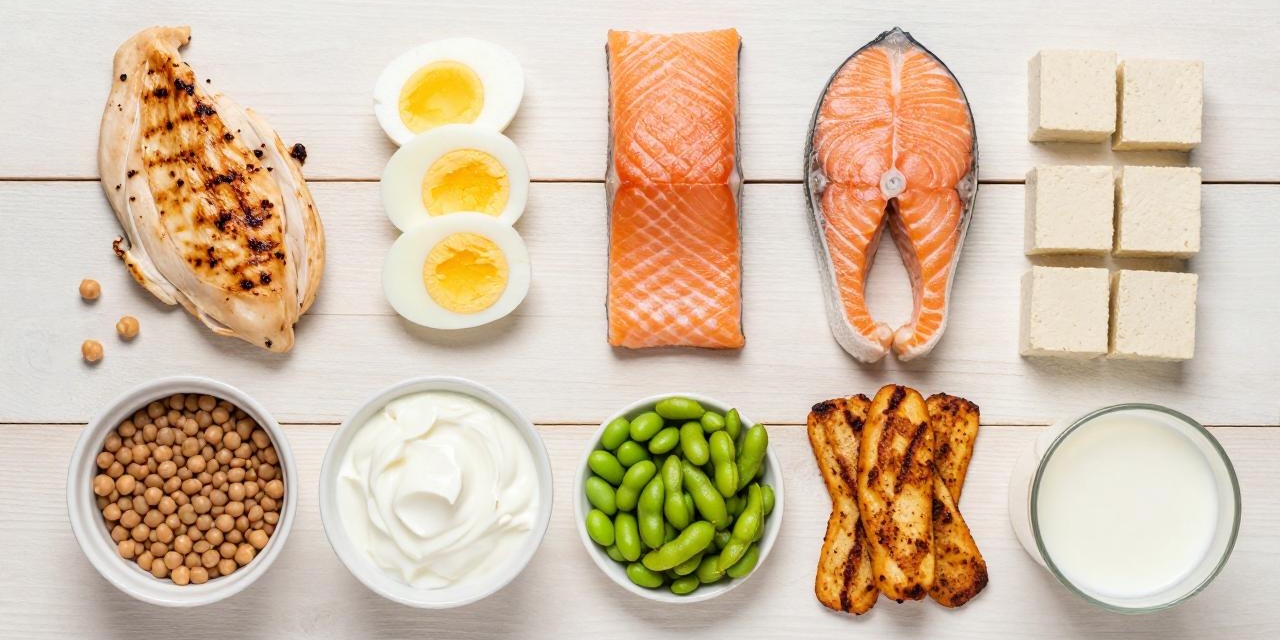
You've probably noticed that protein is everywhere right now: protein bars, protein coffee, protein water (yes, that's a real thing now), influencers doing the "did you get enough protein today?" check-in. Honestly, the hype is earned. There's real science behind why everyone's suddenly obsessed.
It's not just media hype, the federal government weighed in on this too. The 2025-2030 Dietary Guidelines for Americans nearly doubled the general adult protein recommendation, from the old standard of 0.8 grams per kilogram of body weight to a new range of 1.2 to 1.6 grams per kilogram [1][2]. That's not a small tweak! It's worth noting this dramatic increase didn't fully match the recommendation of the government's scientific advisors [3]. Still, if you've been anchoring to that old 0.8 number, it's officially outdated.
Here's the thing most of the protein frenzy misses: protein isn't just about building muscle. That's the headline, but it's nowhere close to the whole story.
Protein Is the Body's Building Material
As a nutrient, protein acts like scaffolding that has a thousand jobs. Nearly every structure in your body, down to the cellular level, is built from protein. Your muscles, sure, but also your skin, your organs, your hair, the enzymes that run your metabolism, the antibodies that fight off a cold, the hormones that regulate your mood and sleep. Protein is the raw material for basically every job in your body.
Break it down further and protein is just chains of amino acids, and your body uses those amino acids like letters in an alphabet, rearranging them to spell out thousands of different structures depending on what it needs to build or repair. "Muscle" is just one word in that alphabet. "Collagen," "Keratin," "Enzymes," "Hormones," and "Immune Cells" are other examples of words in the same alphabet.
That's why "protein is important to build muscle" doesn't do this glorious macronutrient justice. You're not just fueling a gym goal. You're creating the raw material for every structure your body is trying to build or maintain, all at once, all the time.
So How Much Protein Do You Actually Need?
This is where most people get stuck, because the number floating around the internet has ranged wildly depending on who's talking: bodybuilders say one thing, old nutrition labels say another. The new 1.2 to 1.6g/kg federal range gives everyone a solid floor to start from. But it's still a population-wide average, not your number. It doesn't account for your actual body weight, activity level, or goals.
Your actual number depends on a few things stacking together:
- Body weight: protein needs scale with how much mass your body is maintaining, so this is the biggest lever
- Age: protein needs shift over the years; older adults generally need more relative to body weight to maintain the same muscle mass, not less
- Activity level: someone training multiple times a week (lifting, circus, endurance sports) is asking their body to repair and rebuild more tissue than someone who's mostly sedentary
- Goals: maintaining vs. building vs. actively trying to preserve muscle in a calorie deficit all shift the target somewhat
Calculate Your Protein Target
Rather than throw a generic number at you, use this calculator to get a personalized recommendation based on the 2025–2030 Dietary Guidelines:
Eat · Protein Calculator
What's your number?
Your number depends on your body weight, age, and goal: not a flat rule of thumb pulled from the 2025–2030 Dietary Guidelines' 1.2–1.6 g/kg baseline. Every value shown is exactly what the cited research supports, with no interpolated or estimated numbers in between.
Enter your body weight to continue.
Protein needs per kg tend to rise with age to help maintain muscle.
Enter your age to continue.
Your daily target
0
grams of protein per day
This is an educational estimate based on general population research, not personalized medical or clinical nutrition advice. If you're pregnant, managing kidney disease, or have another health condition, check with a registered dietitian or physician before changing your protein intake.
Where these numbers come from: the 1.2–1.6 g/kg maintain baseline (general population) is from the 2025–2030 Dietary Guidelines for Americans, extending to 1.4–2.0 g/kg for people who train regularly per the ISSN position stand (Jäger R, et al. J Int Soc Sports Nutr. 2017;14:20). The 1.6–2.2 g/kg build range, including the 1.62 g/kg plateau, is from Morton et al. 2018 (Br J Sports Med. 2018;52(6):376-384), a meta-analysis of 49 studies and 1,863 participants. The 2.0–2.4 g/kg fat-loss range is from Helms et al. 2014 (Int J Sport Nutr Exerc Metab), based on lean, resistance-trained athletes in a deficit; for adults 60+, it's replaced with a 1.2–1.6 g/kg range from the ESPEN consensus (Deutz NEP, et al. Clin Nutr. 2014;33(6):929-936) and Ishaq et al. 2025 (Front Nutr. 2025;12:1547325, ages 60-75). The age-50+ note reflects Morton et al.'s anabolic resistance finding and isn't applied to fat loss, which wasn't studied that way. There's no activity-frequency dropdown, since none of these sources support splitting by training frequency — Morton et al. tested this directly for build and found no effect — so maintain instead uses a simple yes/no toggle between two distinctly studied populations.
References
- US Department of Health and Human Services, US Department of Agriculture. Dietary Guidelines for Americans, 2025-2030. 10th ed. US Department of Health and Human Services; 2026. Published January 7, 2026. Accessed September 3, 2026.
- HHS releases 2025-2030 Dietary Guidelines for Americans. Healio. Published January 2026. Accessed September 3, 2026.
- Perkins Coie LLP. 2025-2030 Dietary Guidelines for Americans: regulatory update and key changes. Published February 4, 2026. Accessed September 3, 2026. https://www.ashurstperkinscoie.com/en/insights/2025-2030-dietary-guidelines-for-americans-regulatory-update-and-key-changes/
- Morton RW, Murphy KT, McKellar SR, et al. A systematic review, meta-analysis and meta-regression of the effect of protein supplementation on resistance training-induced gains in muscle mass and strength in healthy adults. Br J Sports Med. 2018;52(6):376-384.
- Helms ER, Zinn C, Rowlands DS, Brown SR. A systematic review of dietary protein during caloric restriction in resistance trained lean athletes: a case for higher intakes. Int J Sport Nutr Exerc Metab. 2014;24(2):127-138.
- Deutz NEP, Bauer JM, Barazzoni R, et al. Protein intake and exercise for optimal muscle function with aging: recommendations from the ESPEN Expert Group. Clin Nutr. 2014;33(6):929-936.
- Ishaq I, Noreen S, Maduabuchi Aja P, Atoki AV. Role of protein intake in maintaining muscle mass composition among elderly females suffering from sarcopenia. Front Nutr. 2025;12:1547325.
- Jäger R, Kerksick CM, Campbell BI, et al. International Society of Sports Nutrition Position Stand: protein and exercise. J Int Soc Sports Nutr. 2017;14:20.
Want the Protein Cheat Sheet?
The protein cheat sheet ranks foods by grams of protein per 100 calories, not per serving. This way, large portion sizes won't skew the results
I create companion tools or resources for most articles. The public ones are on our Resources page. The rest, including the Protein Package Tool, live in the Extras.