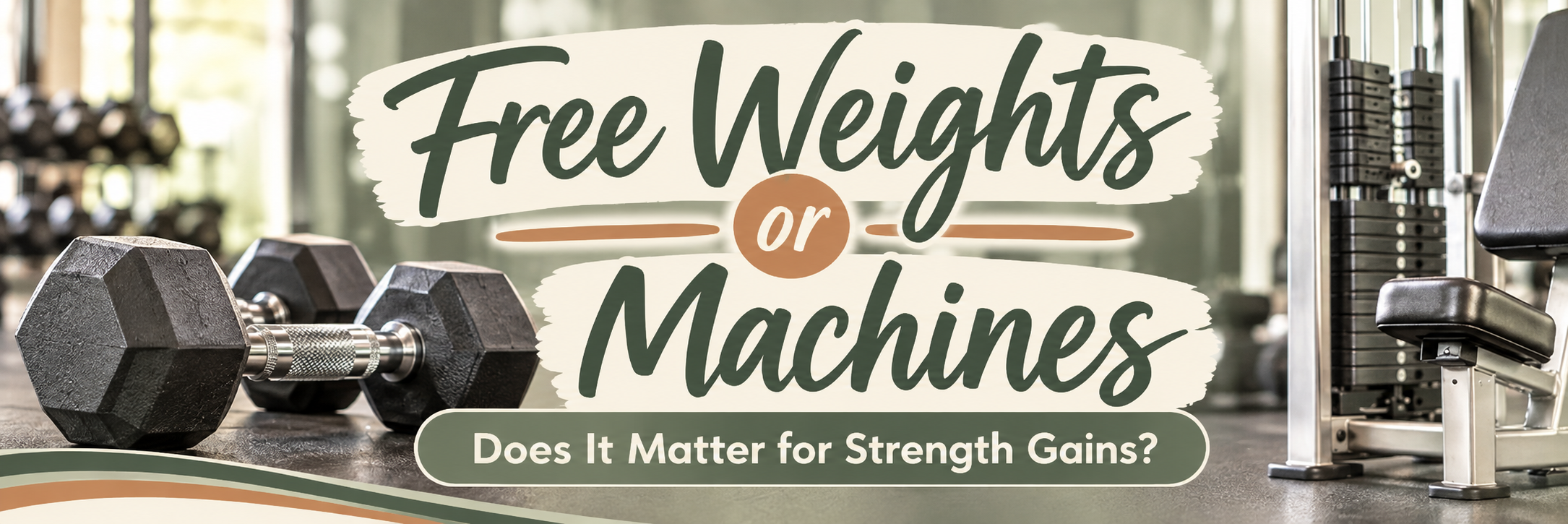
Free Weights or Machines: Does It Matter for Strength Gains?
Free weights or machines? Ask around and you'll get strong opinions, usually delivered like a rule. But when researchers put the two head-to-head, the answer was more encouraging than the gym debate suggests.
One study in the Journal of Strength and Conditioning Research did just that [1]. Here's what the researchers did, what they found, and what it means for how you train.
What the Researchers Did
Thirty-six healthy adults, 21 women and 15 men between the ages of 18 and 30, completed this study. On average, they had a little over two years of lifting experience. They were randomly split into two groups. One group trained only with free weights (barbell bench press, squats, straight-leg deadlifts, rows, chin-ups, dumbbell work). The other trained only on machines (the Smith machine, which is a barbell fixed to vertical rails, plus a mix of cam-based and other weight machines) [1].
Both groups followed the same plan for 8 weeks: each muscle group trained two to three times a week, for three to four sets of 4 to 10 repetitions. The researchers measured muscle thickness with ultrasound, total lean mass with a Bod Pod (air displacement plethysmography), and strength on the bench press and squat before and after. They also measured hormones in saliva around some of the workouts [1].
What They Found
Muscle size went up the same in both groups. Biceps and quadriceps thickness increased with free weights and with machines, and the researchers found no difference between them [1]. Total lean mass (everything in the body that isn't fat) didn't change significantly in either group. That isn't overly surprising after just eight weeks, especially in people who already had a couple of years of lifting behind them [1].
Strength went up the same, too, with one caveat. Free-weight bench press, free-weight squat, and Smith machine squat strength all rose in both groups, by about 11 to 19%, with no difference between them. The one exception was machine bench press strength, where the machine group improved more (13.9% versus 8.6%, a borderline result statistically) [1]. The authors' explanation is something called specificity. Strength was tested as a one-rep max, the heaviest weight a person could lift for a single rep, and the machine group had practiced the Smith machine bench press for eight weeks, so they got better at that exact test [1]. You get best at what you practice.
The study also tracked hormones. Part of the case for free weights is that they may boost muscle-building hormones, so the researchers checked. Men who trained with free weights had a bigger short-term rise in free testosterone after workouts than men on machines. Women in either group didn't show that rise, and cortisol, a stress hormone, didn't differ between groups [1]. But the men on machines built muscle just as well without that rise. The authors conclude that a short-term hormone bump after a workout doesn't seem to translate into extra muscle or strength [1].
Why This Isn't a One-Off
This lines up with the 2026 American College of Sports Medicine position stand, which reviewed 137 systematic reviews. It found that strength was not affected by whether people trained with machines or free weights. For muscle growth, it said there wasn't enough evidence to say either way, and it didn't list equipment type as something that consistently changed training results [2]. Only one of those 137 reviews specifically compared machines with free weights. So a single study and a large evidence review pointing the same way on strength is a good sign, but it isn't the final word.
What This Means for You
If your goal is more muscle and strength, the tool you pick matters much less than whether you train consistently and push yourself. A few practical takeaways:
- Pick what you'll use consistently. If machines feel safer, less intimidating, or easier to learn, that's a perfectly good way to build strength. The same goes for free weights if you enjoy them.
- Free weights are more accessible. They're portable and cheap to use at home (a pair of dumbbells goes a long way). Many lifters also like them for balance and coordination, though this study didn't test that.
- Machines can be a smart starting point. They guide the movement path, so you can focus on effort without worrying about balance. That's helpful when you're new, returning from a break, or training near fatigue without a spotter.
- Mixing is fine. You don't have to choose a side. Using both can keep training interesting and let you work around equipment limits or sore spots.
- Practice the lift you care about. If you want a stronger barbell squat, do some barbell squats. Strength is specific, and that machine bench press result is a good reminder.
Keep in Mind, the Focus Was Strength
This study looked at muscle size and strength, so that's all this post covers. Balance, proprioception (your sense of where your body is in space), and range of motion weren't measured and weren't the goal of the study. Here, strength means how much weight someone could lift in a test: their one-rep max on the bench press, and a close estimate of it on the squat.
The Takeaway
For building muscle and strength, free weights and machines worked about equally well in this study, and a major review of the evidence agrees when it comes to strength. This makes my exercise physiology heart so happy, because it means you get to pick your favorite. Pick the tool you'll use consistently, train hard enough that it feels challenging, and keep showing up.
References
- Schwanbeck SR, Cornish SM, Barss T, Chilibeck PD. Effects of training with free weights versus machines on muscle mass, strength, free testosterone, and free cortisol levels. J Strength Cond Res. 2020;34(7):1851-1859.
- Currier BS, D'Souza AC, Fiatarone Singh MA, et al. American College of Sports Medicine position stand: resistance training prescription for muscle function, hypertrophy, and physical performance in healthy adults: an overview of reviews. Med Sci Sports Exerc. 2026;58(4):851-872.
Want more evidence-based tools like this?