
The Boring Math Behind Every "Miracle" Diet
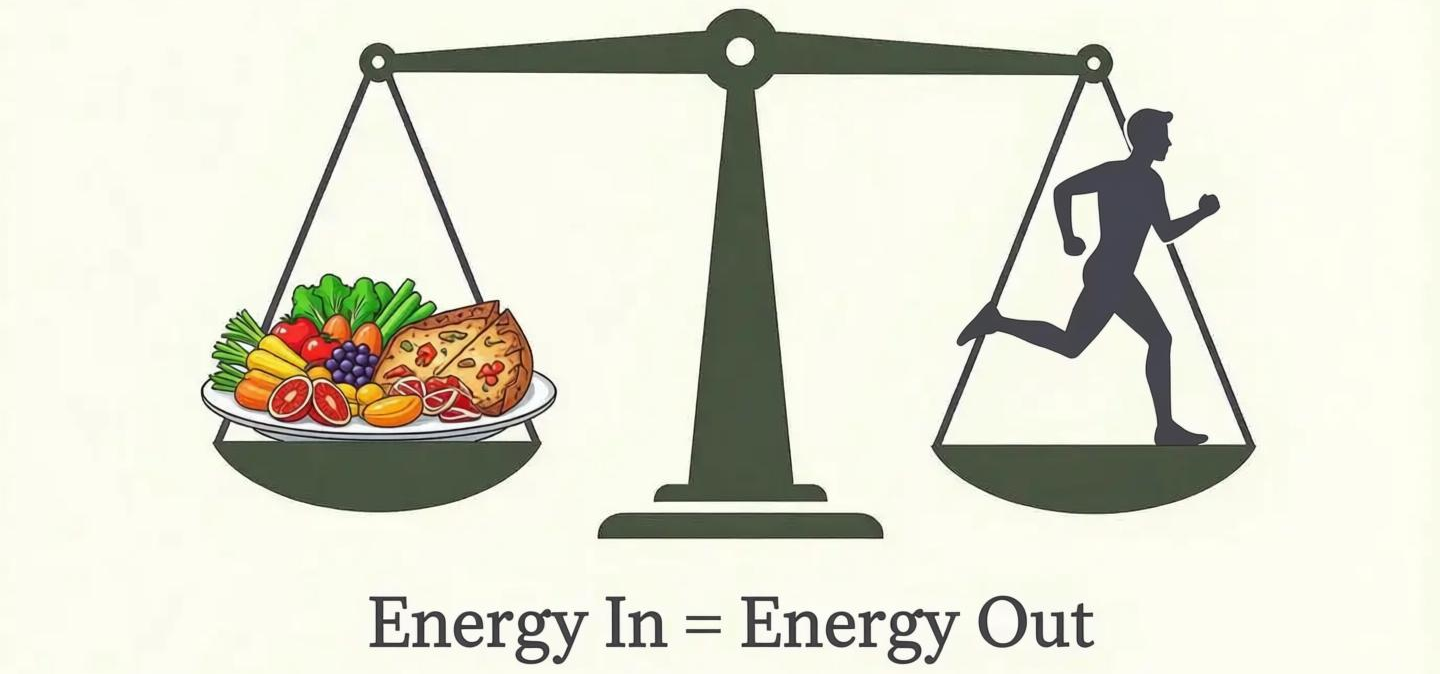
People follow a vegan, keto, carnivore, or intermittent fasting diet for all kinds of reasons, blood sugar control, satiety, simplicity, cutting out inflammatory foods, ethics, etc. But when it comes to whether any of them change your weight, they're all running on the same underlying math: energy balance, the relationship between what you're taking in and what your body is putting out.
What Is a Calorie
A calorie is just a unit of energy, specifically the amount of energy it takes to raise the temperature of one kilogram of water by one degree Celsius. Food contains calories because your body can extract usable energy from it. That's genuinely all a calorie is: not a moral category, not a good or bad label, just a measurement of energy.
Energy balance is what happens when you compare the calories you consume against the calories your body uses. Take in more than you use, and you're in a calorie surplus. Use more than you take in, and you're in a deficit. Match the two, and you're at maintenance. Nearly everything about weight change comes down to this relationship over time, even though the factors on both sides of it are more complex than a single number suggests.
What Determines Calories Burned?
How many calories you "burn" in a day isn't one thing. It's several components stacked together:
- Resting metabolic rate (RMR): the energy your body uses just to keep you alive at rest, breathing, circulating blood, running your organs. This is the biggest piece of the total for most people, often 60 to 75%.
- Thermic effect of food (TEF): the energy your body spends digesting and processing what you eat. Protein costs more to digest than fat or carbs, which is part of why it's often highlighted in weight management.
- Exercise activity: calories burned through intentional workouts.
- Non-exercise activity thermogenesis (NEAT): everything else that isn't formal exercise. Walking around, fidgeting, standing instead of sitting, doing chores. This varies enormously between people and is often underestimated [1].
Add all of that together and you get total daily energy expenditure (TDEE), the real number that matters for energy balance, not just "how much did I exercise today."
How to Estimate Your Calorie Burn
Without a metabolic cart and a lab, you can't get an exact number, and it's worth saying clearly: any formula you use is an estimate, not a precise measurement. But an estimate is still useful. A few common approaches:
- Predictive equations (like Mifflin-St Jeor or Harris-Benedict) use your weight, height, age, and sex to estimate RMR, then apply an activity multiplier on top. Quick and reasonable for most people, though less accurate at the extremes of body composition [2].
- Wearables and apps estimate expenditure using heart rate and movement data. Convenient, but accuracy varies a lot depending on the device.
- Direct tracking over time: this is the most reliable low-tech method. Track your food intake and your weight consistently for a few weeks. If weight is stable, whatever you're eating is roughly your maintenance number. If it's changing, you can calculate your real deficit or surplus from the trend.
I built a free calculator that estimates your RMR from your stats, then lets you turn that into a rough daily calorie estimate based on your activity level [3]. Treat both numbers as a reasonable starting point to adjust from, not a fixed target carved in stone.
Part of the Metabolism Series
Find your RMR and daily calorie estimate
Used because the standard RMR equation accounts for typical differences in body composition between sexes.
Enter your weight to continue.
Enter your age to continue.
Uses the same unit system as your weight above.
Enter your height to continue.
This is used to calculate your second result, Total Energy Expenditure, below.
Here are your two numbers at a glance.
RMR
—
at rest
TEE
—
full day
Result 1
Resting Metabolic Rate (RMR)
—
calories / day
What your body burns just staying alive: breathing, circulating blood, running your organs. This is measured at complete rest, before any movement, exercise, or digestion. Think of it as your floor, not a target to hit.
Result 2
Total Energy Expenditure (TEE)
—
calories / day
Your RMR plus the energy you burn moving through your day, including the activity level you selected above. This is a rough estimate of your full daily calorie needs to maintain your current weight.
Both numbers are estimates, not measurements. Use them as a starting point to adjust from based on how your body actually responds over a few weeks, not as fixed targets.
Now for the Other Side of the Equation: Tracking What You Eat
Everything above covers energy out. But energy balance has two sides, and the intake half deserves the same attention.
If you want to get a real read on your own intake, there are a lot of great tools out there. MyFitnessPal, for example, is a free app that maintains a huge food database and does the math for you. You can always track by hand instead (I did, back before I knew apps like this existed), it's much slower and leaves more room for human error in the calculations, but it can also help you register the macronutrient and micronutrient content of the foods you're eating, in a way that just tapping into an app might not.
If you do track, aim for at least three days, and make sure one of them is a weekend day. Weekday and weekend eating patterns are often different enough that a weekday-only snapshot won't give you the full picture. Once you've got those three days logged, add up the totals and divide by three, that average is the number you'll want to compare against your energy balance, not any single day on its own.
Output from the calculator, intake from tracking, put them together and that's your estimated energy balance. Hold onto it. Whether you're working toward weight, recovery, energy, hormones, or strength, this number is fundamental. If you haven't run your numbers yet, scroll back up and try the calculator.
References
- Levine JA. Non-exercise activity thermogenesis. Proceedings of the Nutrition Society. 2007;65(3):353-360.
- Frankenfield D, Roth-Yousey L, Compher C. Comparison of Predictive Equations for Resting Metabolic Rate in Healthy Nonobese and Obese Adults: A Systematic Review. Journal of the American Dietetic Association. 2005;105(5):775-789.
- Academy of Nutrition and Dietetics. Determination of Resting Metabolic Rate. Evidence Analysis Library. andeal.org/template.cfm?template=guide_summary&key=621